Tools for distraction that could help you to stay focused?

Staying focused is essential for many of us in our work lives. Tools for distraction can provide a helpful menu of ideas to refocus or have something to look forward to when we need it the most.

Ironically, sometimes, we need a short-term distraction to keep ourselves on task or to help us get back on track when unsure where to go next. In the same way, noise can be a distraction, but getting the right amount and type of background noise can help us stay in the present.

Here are examples of what I’ve found helpful to regroup and refocus. They are simple tools or toys that enable me to stretch and move my thinking in ways that can support me to move forward with the task.

They are the gifts that keep on giving time and time again, I can go back to them when I need to.  These are my gifts to you!

Note of caution

Suppose you use these devices at work, in a meeting, or in a social setting, where people might not know how essential tools for distraction actually help you to stay focused. It’s important to let them know what you’re doing and why; otherwise, they might wrongly assume you’re bored or just being rude.

Transparency notice

Some affiliate links are included in this article for the items listed on Amazon for which I will receive a small percentage of the purchase price. This does not affect the price you pay; I intend to do something good with the funds generated.

IQ Fit Smart Games

IQ Fit make a series of puzzles that can be reused differently. These are often mentally challenging and offer a way to reset my thinking before I move back to the task I was losing focus on.

I’ve particularly enjoyed games that include IQ Fit, IQ Focus, IQ Link, IQ Six Pro, IQ Stars and IQ Twins.

If you would like to find out more about these games, check them out here www.smartgames.eu/uk/collection/pocket-games.

IQ Fit Smart Games for distraction control

Perplexus

Perplexus offers a spherical game that is effectively a ball race and a great tool for distraction control. This demands concentration and a great deal of hand and eye coordination. I found this game particularly challenging but fun over the Christmas period. It’s one I can pick up and put down as it promotes a tremendous amount of interest and conversation in my household – so it serves in different ways! Many other options are available from Perplexus, including themed games such as Star Wars and the Death Star. I’d encourage you to start with this simple option.
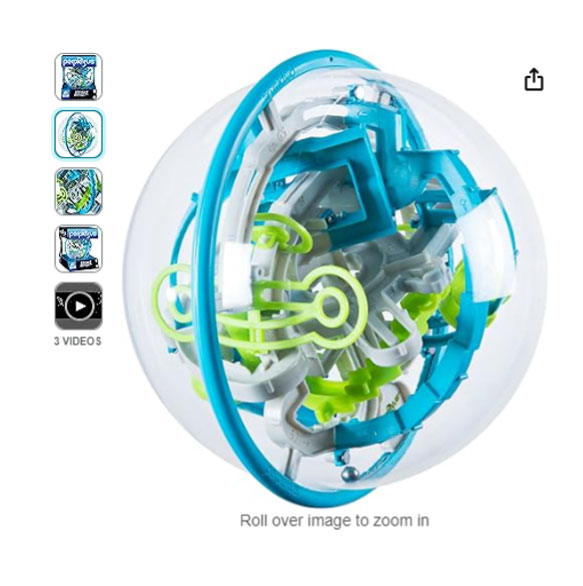
https://www.amazon.co.uk/Cardinal-Games-6053147-Perplexus-Multicoloured/dp/B07MKCZJNJ/ref=sr_1_2?crid=KYY9YPHGYLJ6&keywords=Perplexus&qid=1704457785&sprefix=perplexus%2Caps%2C102&sr=8-2

Perplexus

Rubik’s Cube

The Rubik’s Cube offers many options in different shapes and sizes. Although the puzzle itself is tricky, it can be solved. There are also great ways to learn how to solve the Rubik’s Cube, like this tutorial from J Perm: https://www.youtube.com/watch?v=7Ron6MN45LY

He talks you through a series of moves step-by-step so you can solve the puzzle. This makes what has felt impossible possible! It’s an ideal distraction and a valuable tool for resetting and working out what you will do next. It’s a familiar game, and within a short period, I can return to the task I was working on.

If you don’t already have a Rubik’s cube, I recommend getting a speed cube as it has a smoother movement and feels good in your hands. I discovered that the one below works well. It’s smooth, fast, and adaptable as you improve, unlike the original Rubik’s cubes, which are typically stiff and difficult to solve quickly.
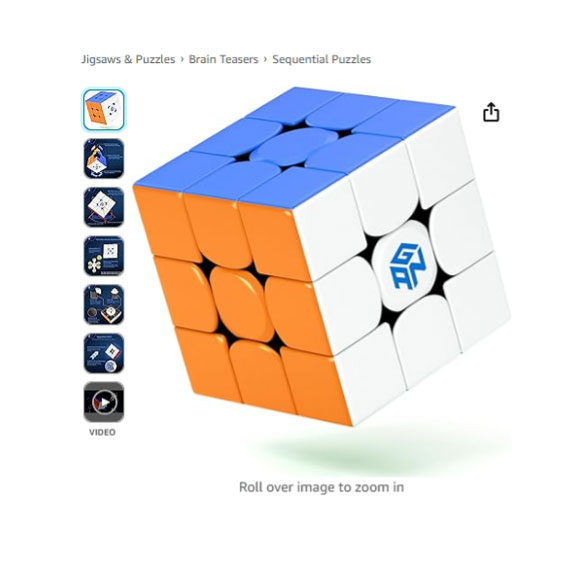
https://www.amazon.co.uk/Roxenda-Stickerless-Gan356-System-Speedcube/dp/B07PKMLM7S/ref=sr_1_21_sspa?crid=2ZHP9JQOJGUW0&keywords=Tunic%2Bcube&qid=1704457813&sprefix=tunic%2Bcube%2Caps%2C81&sr=8-21-spons&sp_csd=d2lkZ2V0TmFtZT1zcF9tdGY&th=1

Rubik’s Cube

Desk-based timer

These days, we have many ways of recording time on our computer or phone or looking at a wall clock, but often, it’s hard to set these up frictionlessly when we need to capture a moment in time or record a specific amount of time.

The Pomodoro timer is one such device that I place on a surface with the corresponding amount of minutes I’d like to measure. It means I can quickly take 15 minutes, for example, to think about my next task. This means my time does not drift. This is particularly important for individuals who find time awareness challenging. It can also help you to assess how long it’s taken to complete a task, which can be helpful when trying to estimate how long tasks take. This device sits outside of all the other technology – it’s not dependent on another device being opened or activated, so you don’t get distracted. If you’re interested in finding out more, check out the device here.
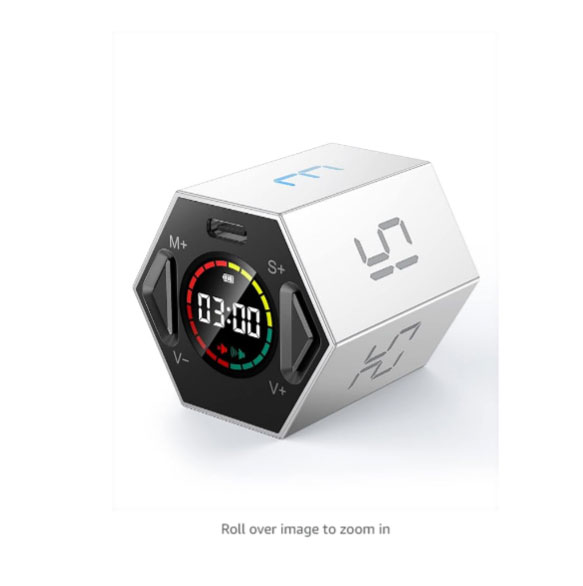
https://www.amazon.co.uk/Kitchen-Digital-Magnetic-Countdown-Function/dp/B08KJJXQS4/ref=sr_1_3_sspa?crid=1E3IU2N8KTRS6&keywords=pomodoro%2Btimer&qid=1704458269&sprefix=pomo%2Caps%2C70&sr=8-3-spons&sp_csd=d2lkZ2V0TmFtZT1zcF9hdGY&th=1

Desk-based timer

Seconds app

Sometimes, we need something more than a simple timer; for example, if we have routines or methodologies we want to build and repeat. An excellent example of this is exercise routines.  I’ve been working on a static exercise routine to help my youngest son sleep. What I mean by this is instead of exercises that increase his heart rate, these are exercises that use his strength to make him tired. This seems to be working, but we’ve had to experiment with lots of different exercises to find the ones he likes and make it fun.

The Seconds app provides a great way of structuring these exercises, and now that we know the exercises he likes, I can play them back to him. We include time for a warmup, a rest and repeating time, as well as being able to copy and paste exercises.

It also has features that allow you to incorporate music, the option to share the workout and the ability to see it in the foreground or background of your mobile device. The display has clear colour boundaries showing different items, which is simple yet effective.

I can’t recommend this enough, and at £1.50, it’s a giveaway.

See for yourself: https://www.intervaltimer.com
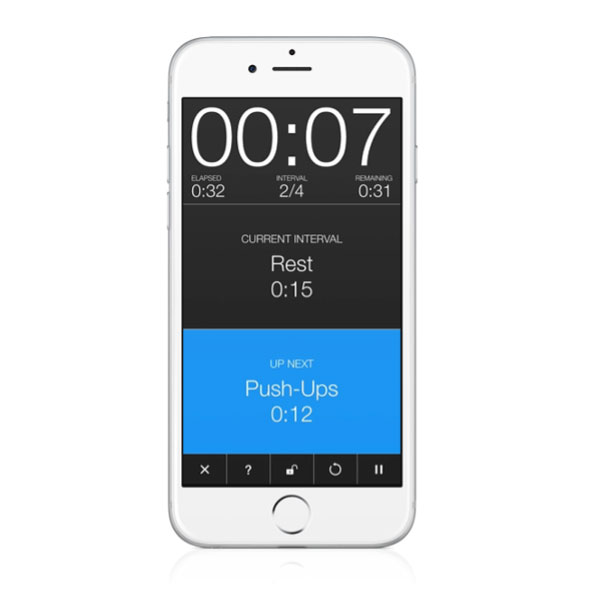
Seconds app

I hope you have enjoyed my gifts and they help you on your journey into neurodiversity.

Which ideas will you try?

When you are ready, here are three ways we can connect:

A blog about services

For employers

Workplace Needs Assessment

This is for individuals who are having difficulties with everyday tasks in the workplace and aims to make recommendations to help improve the effectiveness of the individual.

Neurodiversity Awareness Training

An introduction to neurodiversity that will help people understand the various neurodivergent conditions such as dyslexia, dyscalculia, autism, dyscalculia and ADHD.

Leadership Coaching

This supports leaders in their thinking journey and is especially useful when considering neurodiversity within the workplace. This coaching can be focused on supporting leaders from neurominority groups.

For individuals

One-to-one Coaching

This service helps neurodivergent individuals deal with everyday life more effectively. It is designed to build on existing skills, and introduce new ones focused on improving workplace effectiveness.

Technology Mentoring

Assistive technology mentoring is about helping you understand how technology can solve your workplace difficulties. What’s important is finding solutions that work for you in your workplace.

Workplace Needs Assessment

This is for individuals who are having difficulties with everyday tasks in the workplace and aims to make recommendations to help improve the effectiveness of the individual.

Accredited courses

Dyslexia Champions™

This program equips individuals to be good listeners, approachable, knowledgeable and impartial and will help them become ‘qualified to guide’ colleagues to support neurodivergent conditions.

Neuroinclusive Practice™

This program is designed to equip leaders, line managers, supervisors and HR personnel to ‘spot the signs’ and be able to effectively manage and support neurodiverse staff in the workplace.

Defending boundaries: When RSD (Rejection Sensitivity Dysphoria) turns up!

Struggling with boundaries is a reality for many of us, especially as we try to make life better in a world where it’s not always clear how other people perceive us. But with RSD (Retention Sensitivity Dysphoria), it can be even more challenging.

Why our boundaries fall

Our boundaries fall because we don’t put limits in place to defend them and reset when life goes wrong. Rejection Sensitivity Dysphoria (RSD) is one of the traits that can be dangerous to our boundaries. This turns up with other neurodivergent conditions like ADHD, but it’s also present for all of us in some ways, unless your behaviour looks psychopathic (sorry, Donald Trump).

I’ve seen rejection sensitivity make individuals highly sensitive to the possibility of rejection, meaning they take on tasks that don’t serve them. They want to accommodate the needs of others. This can be incredibly debilitating, and as a result, individuals make poor decisions that don’t serve them well.

Have you planned your schedule by deciding what’s important to you and then changed your plans as you believe it will affect how others perceive you? For example, you might have agreed to write a book and set aside time for it, but you often end up giving that time to other work as you think it’s important to another person. This happens because of your inaccurate perception of what other people think of you.

Sometimes, you can isolate yourself to prevent RSD, so you stop collaborating with the right people. These people will hold you accountable for what you have agreed with yourself. This can sabotage the structure that helps you thrive. There’s incredible power in ‘us’, collaboration and accountability.

Why partnership is important with RSD

The key is a good partnership, where you consciously ask for constructive feedback. If feedback hasn’t been given helpfully, it can shut off that channel, which breaks down the opportunity to partner and puts boundaries in danger. There can be feelings of misunderstanding and a feeling like you don’t fit in. I worked with someone who explained that they felt like an alien when they were at school. They described knowing the answer but often unable to articulate it, which meant they didn’t fully participate. Understanding these feelings of not fitting in is essential, or you can judge yourself too harshly and have an overly negative and inaccurate view of yourself. This can often be useful to explore during a coaching conversation.

How does this turn up?

For instance, there are times when people feel hesitant to share their thoughts because they fear they might sound foolish. This can lead to missed opportunities and frustration at work. It’s crucial to recognise and address this issue by creating organisations that encourage people to bring their best and most effective selves to work.

Self-esteem can play a crucial role, too. How can you defend your boundaries if you don’t love yourself? This is a powerful idea as it might be a hindrance if you define your significance by other people’s approval. Anything that damages that approval can take you to a difficult place.

Is getting to know new people difficult as you define yourself by others’ thoughts about you? In an ideal world, people’s opinions should be their business, not yours, but this can feel like a wrestling match; worrying about what others think can mean you are less of yourself.

For some individuals, this turns up by playing back every conversation and social interaction, going over what’s been said, analysing what went wrong, what the other person thought, and how your words landed.

Have you ever spent time worrying about your conversations and not allowing the communication to sit? This behaviour can often put a lot of pressure on you and ultimately put you in a position where you cannot move forward.

How to start to move the needle on RSD

Helping change your perspective on this can be helpful, and there are various tools you can put in place to support you or anyone in your team to move forward. For example, when in negotiations or trying to understand how best to work with someone, individuals can give up their boundaries entirely because they are more concerned if they’ll be liked, often sacrificing doing what’s best for both parties.

One of my favourite quotes is by Nelson Mandela: “Do not judge me by my success; judge me by how many times I fell and got back up again.” How will you respond when boundaries fail? Will you run from them, or will you return and rebuild them?

Maintaining boundaries with RSD

You can maintain your boundaries and handle RSD by using strategies and being accountable for your actions. Start by having a conversation with yourself about recent events, identify which boundaries were crossed, and figure out how to adjust them moving forward. Establish accountability structures to stay aware of the situation and take actions that benefit you. Remember, you can’t change the past or others’ actions, but you always have the power to choose your next steps.

I’ve been reading Rise by Siya Kolisi (South African Rugby Captain, 2x World Cup winner), and he said, “I’m at the point in my life now where I don’t care what other people think.” This doesn’t make him any less caring; it just means that he focuses on what he can achieve, which is an excellent way of thinking about life.

Think about…

What will you do to maintain and defend your boundaries today?

What are your next steps?

At The Neurodivergent Coach, we specialise in supporting individuals to build effective boundaries and defend them well. If you’d like a conversation, please get in contact.

When you are ready, here are 3 ways we can connect: